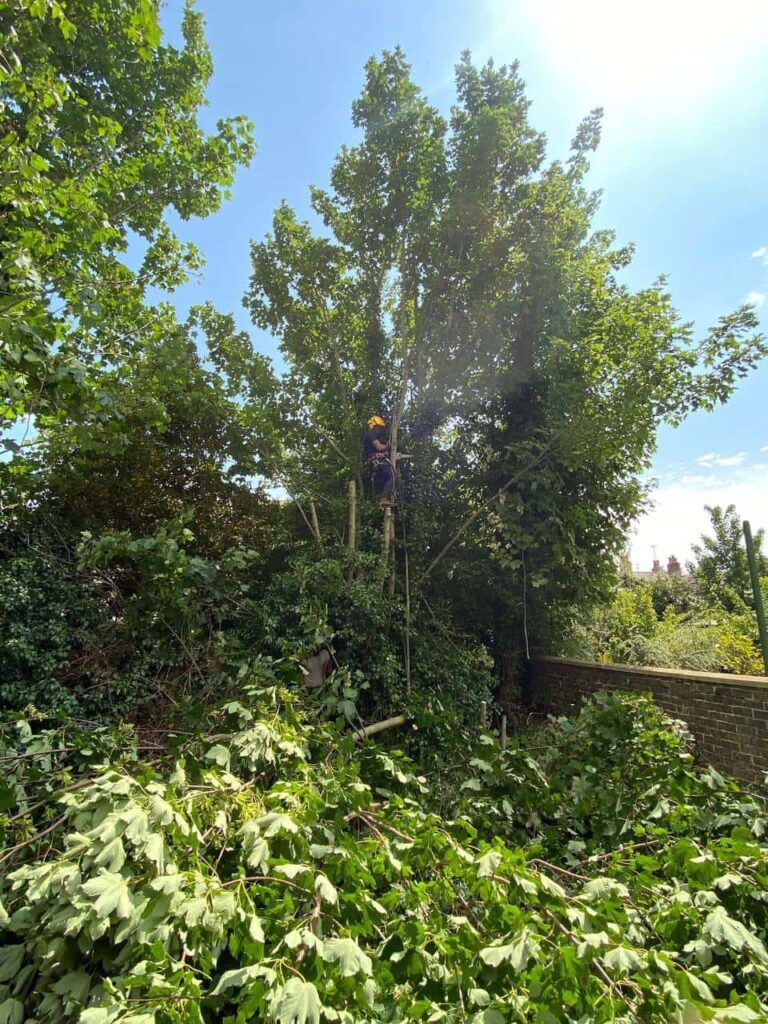
A problem tree does not always need to be removed. Many concerns can be managed through professional pruning, crown reduction, deadwood removal or ongoing monitoring. However, there are circumstances in which these measures cannot provide a suitable long-term solution.
Tree felling may be appropriate when a tree has lost its structural integrity, entered irreversible decline or become fundamentally unsuitable for its surroundings. The decision should follow a careful assessment of the entire tree, including its roots, trunk, canopy, condition and position.
How Is the Need for Tree Felling Determined?
The most obvious defect is not necessarily the most important one. A broken branch may be relatively straightforward to remove, while concealed decay at the base of an otherwise healthy-looking tree could have more serious implications.
A professional assessment should consider:
- The health and vigour of the tree
- The condition of its trunk and principal branches
- The stability of its root system
- The amount and location of any decay
- Whether defects are localised or widespread
- The tree’s ability to respond to remedial work
- Its position in relation to surrounding features
- Whether pruning could provide an effective alternative
Tree felling becomes a reasonable option when retaining the tree is unlikely to resolve the underlying problem or would leave an unsuitable structure.
The Tree Is Dead or Cannot Recover
A dead tree no longer produces healthy new growth and will gradually lose structural strength as its wood deteriorates. Branches may become brittle, while decay can spread through the trunk and root system.
A declining tree is different from a dead one. Sparse foliage, small leaves or isolated dieback may result from temporary stress or a manageable condition. The extent of the decline and the amount of healthy tissue remaining must therefore be evaluated.
Felling may be recommended where deterioration is advanced, recovery is unlikely and continued branch removal would not preserve a viable tree.
Decay Has Weakened Essential Structural Areas
Decay does not automatically mean a tree must be removed. Some trees continue growing successfully despite cavities or localised damage. The deciding factors include where the decay is located, how far it has spread and how much sound wood remains.
Damage affecting the lower trunk, root plate or a major branch union can be particularly significant because these areas support much of the tree’s weight. Possible indicators include:
- Large cavities in the trunk
- Fungal growth around the base
- Cracks extending through major unions
- Loose or lifting bark
- Soft or crumbling wood
- Sections of the canopy dying back
Where essential structural areas have been extensively weakened, pruning the canopy may reduce some weight but will not restore the lost strength.
Root Problems Have Affected Stability
Roots anchor the tree and support its access to water and nutrients. Serious root damage can therefore influence both structural stability and general health.
Warning signs may include newly exposed roots, lifting soil around the base, a developing lean or fungal growth close to ground level. Construction activity, soil compaction and significant changes around the root zone can also affect performance.
Because most roots are hidden, their condition cannot always be judged from a simple visual inspection. If damage has substantially reduced the tree’s anchorage, removal may be more appropriate than retaining a structure with uncertain stability.
Storm Damage Is Too Extensive for Pruning
Trees can often recover from the loss of one or more smaller branches. Professional pruning can remove damaged wood and create suitable cuts that allow the remaining canopy to develop.
Felling may become necessary when storm damage has split the main trunk, lifted the root plate or removed such a large proportion of the crown that a stable, balanced framework cannot be retained.
The assessment should consider the condition left behind after remedial pruning. Removing damaged sections has limited value if the remaining tree would still be structurally weak or severely unbalanced.
The Tree Has Become Unsuitable for Its Location
A healthy tree may still create persistent problems when its mature size is incompatible with the available space. Its canopy might repeatedly obstruct access or press against nearby features, while restricted growing conditions may prevent balanced development.
Pruning is often the first option, but not every species tolerates severe or repeated reduction well. Excessive cutting can produce weak regrowth, spoil the tree’s natural form and create the need for increasingly frequent work.
Felling may be the more practical approach when no reasonable form of pruning can achieve lasting clearance while preserving a healthy and balanced tree.
Repeated Work Is No Longer Solving the Problem
A tree that regularly sheds damaged branches or requires frequent corrective work may need a broader reassessment. Repeated pruning can manage symptoms, but it will not reverse advanced decay, serious root damage or progressive structural failure.
This does not mean that a tree should be felled simply because it requires maintenance. Healthy trees naturally need periodic care. The concern arises when each intervention provides only temporary relief and the underlying defect continues to worsen.
Reviewing the pattern of previous problems helps establish whether further remedial work remains worthwhile.
Can the Tree Be Retained Instead?
Before recommending felling, suitable alternatives should be considered. Depending on the tree and the nature of the problem, these may include:
- Removing dead, damaged or crossing branches
- Reducing the crown to lessen excessive weight
- Shortening individual limbs to improve clearance
- Reshaping an unbalanced canopy
- Monitoring a stable defect for future change
- Improving conditions around the root zone
The correct approach depends on the species, maturity, condition and natural growth pattern of the tree. Work should be proportionate to the actual problem rather than based solely on its size or appearance.
Why Professional Assessment Matters
Tree defects can be difficult to interpret from ground level. A tree that looks unhealthy may have a manageable condition, while a full canopy can sometimes conceal structural weakness.
Professional assessment enables the cause and extent of the problem to be identified before work begins. It also helps determine whether pruning can retain the tree successfully or whether felling offers the most responsible long-term outcome.
For property owners in Linton, Cambridge, obtaining informed advice can prevent unnecessary removal while ensuring that genuinely problematic trees are dealt with appropriately.
Conclusion
Tree felling is usually the right option when a tree is dead, irreversibly declining, seriously unstable or fundamentally unsuitable for its position. It may also be appropriate when storm damage, widespread decay or recurring structural problems cannot be resolved through careful pruning.
The decision should always be based on the condition of the complete tree and the realistic value of alternative work. Linton Tree Surgeons provides professional tree assessments and tree felling services in Linton, Cambridge. If you are concerned about a problem tree, contact the team to arrange an assessment and receive clear guidance on the most suitable course of action.
Call us on: 01223 919 495
Click here to find out more about Linton Tree Surgeons
Click here to complete our contact form and see how we can help with your tree needs.